
Facilities & Equipment
The Environmental Change Laboratory (Johanson Lab) is built around one workflow: bringing sediment, water, and soil back from the field and turning it into an environmental record. Everything needed to go from a raw core or surface samples to a counted, dated, and interpreted dataset happens in one room, and the people who collect the samples are the people who process them.
The Laboratory
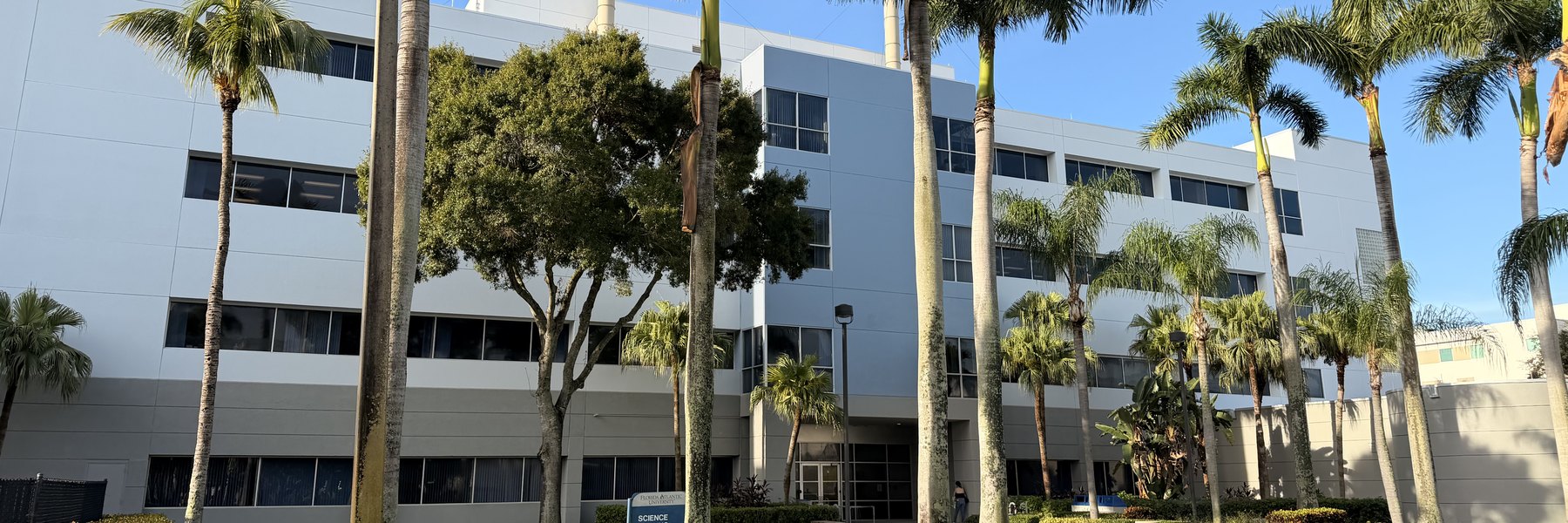
The lab occupies dedicated research space in the Science Building on FAU’s Boca Raton campus. It combines a wet laboratory with a chemical fume hood for palynological and microplastics chemistry, microscopy stations with digital imaging, sediment preparation and drying areas, refrigerated core storage, and bench and desk space for the lab’s graduate and undergraduate researchers.
The lab is a USDA APHIS–permitted facility for receiving foreign and domestic soil and sediment, which allows samples from our international field sites to be imported and processed here under federal soil-handling requirements.
From Field to Record
Coring lakes and wetlands
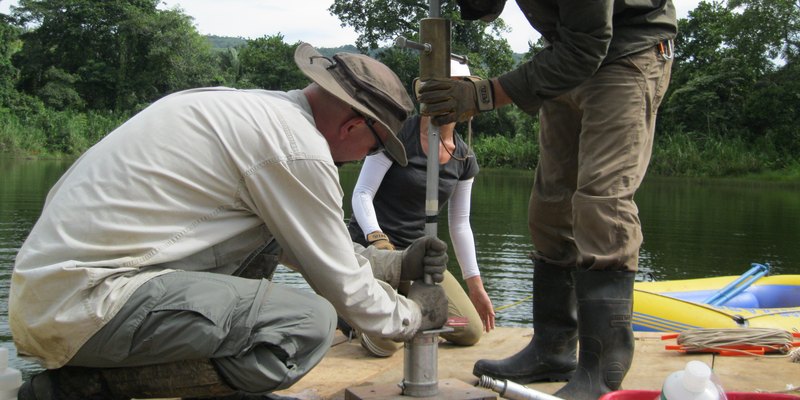
A locking piston coring system worked from a floating platform recovers continuous sediment sequences from lakes and wetlands, with an interface sampler for the intact mud–water boundary and a Russian corer for peat. Departmental vibracore and field vehicles support larger campaigns.
Surface and water sampling
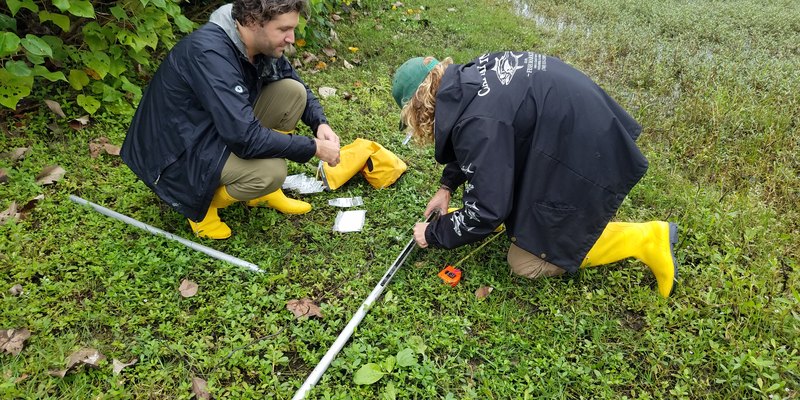
Surface sediment, soil, water, and vegetation are sampled for microplastics and other contaminants, alongside in-situ water-quality measurement, bathymetric survey of coring sites, and GIS mapping of the surrounding landscape.
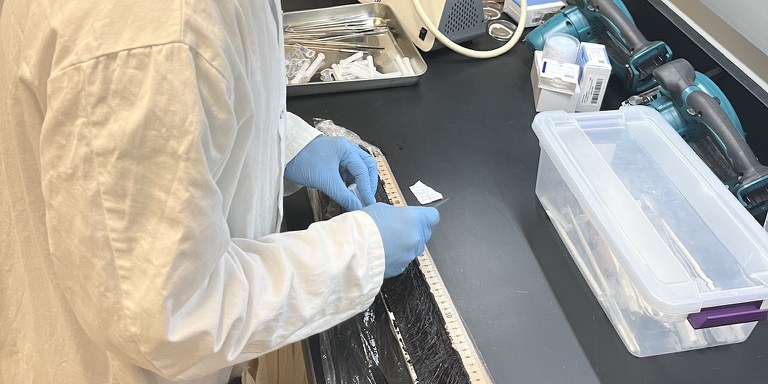
Opening the core
Back in the lab, cores are split, photographed, described, and subsampled at fixed intervals. Every downstream analysis, from pollen to geochemistry to radiocarbon, traces back to this depth scale.
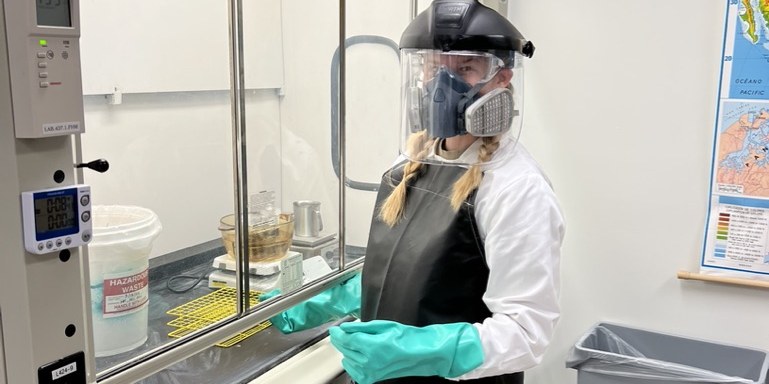
Sediment chemistry
Standard palynological preparation concentrates pollen, spores, and charcoal from a few cubic centimeters of sediment. The same fume hood handles digestion for microplastics and the acid pretreatment of radiocarbon and isotope samples.
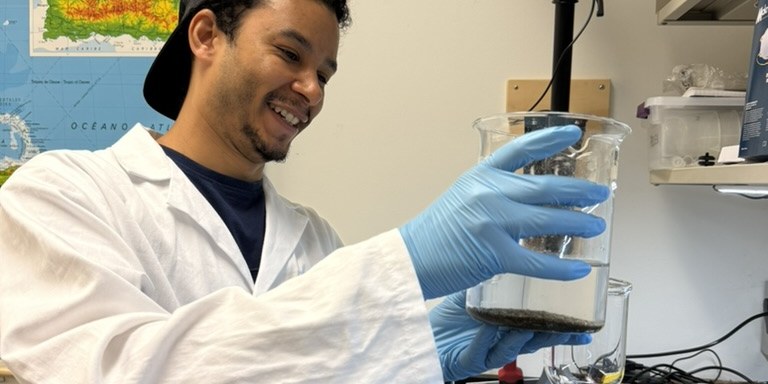
Separating microplastics
Density separation floats plastic particles out of sediment and soil; organic matter is digested away and the remainder is vacuum-filtered for counting. The workflow runs on sediment, water, and vegetation samples with contamination controls at every step.
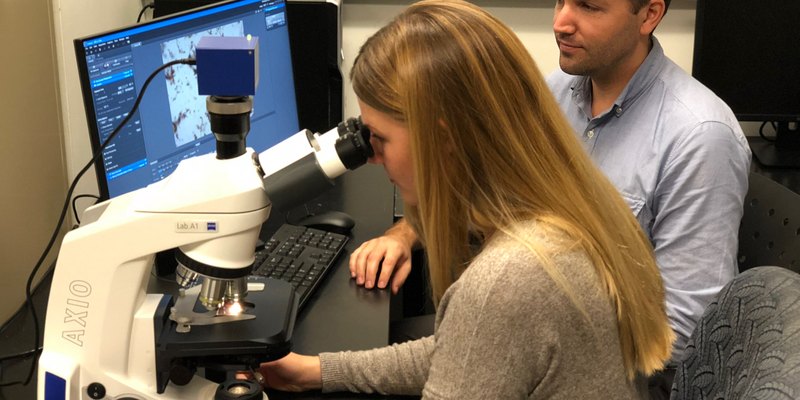
Pollen, spores, and diatoms
Counting under phase-contrast compound microscopy with digital image capture, supported by a growing reference collection of Neotropical and South Florida pollen. Each sample yields the plant community around the site at one moment in the past.
Charcoal and fire history
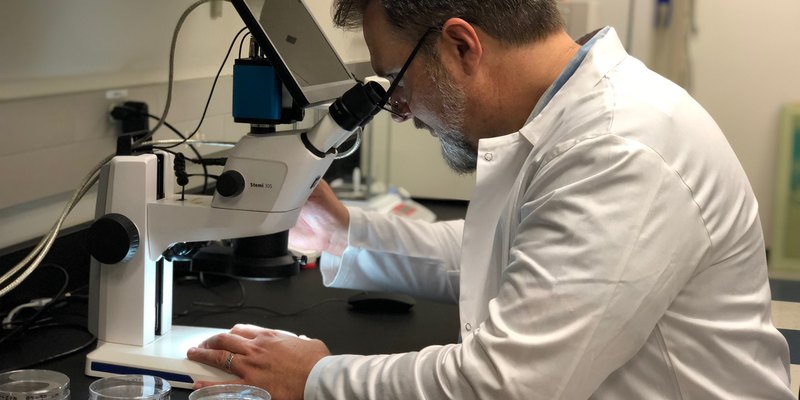
Sieved macroscopic charcoal and microscopic charcoal on pollen slides are counted under stereomicroscopy, together with plant macrofossils, to reconstruct local and regional fire through time.
Identifying particles
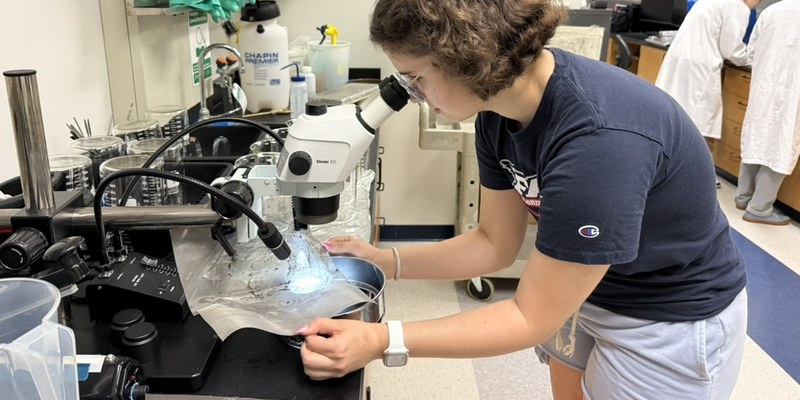
Filters are scanned under the stereomicroscope to identify, classify, and pick microplastic fragments and fibers. A subsample of picked particles goes to FTIR spectroscopy for polymer confirmation, and counts are corrected using the confirmation rate.
Characterizing the sediment
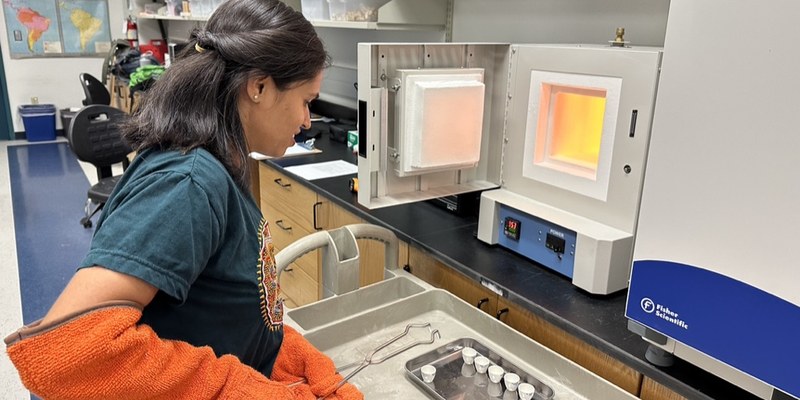
Loss-on-ignition for organic matter and carbonate, magnetic susceptibility, dry bulk density, and elemental profiling by handheld X-ray fluorescence give the physical and geochemical backbone of each record. Stable isotope and radiocarbon samples are prepared here and analyzed with partner facilities.
Pollen Imaging Platform
With the Francis Lab in Biological Sciences, we are building a high-throughput pollen imaging platform: automated slide scanning, networked storage for the image library, a curated South Florida pollen reference set, and machine-learning identification, developed to make pollen analysis faster and reproducible for both paleoecology and pollination ecology.
Working in the Lab
Students in the lab are trained on every step of this workflow, from coring and sample handling through chemistry, microscopy, and data analysis, and process their own samples from start to finish. Equipment in the lab is used by lab members and by collaborators on joint projects. The lab is a research laboratory rather than an analytical service; researchers interested in collaborative projects are welcome to get in touch.